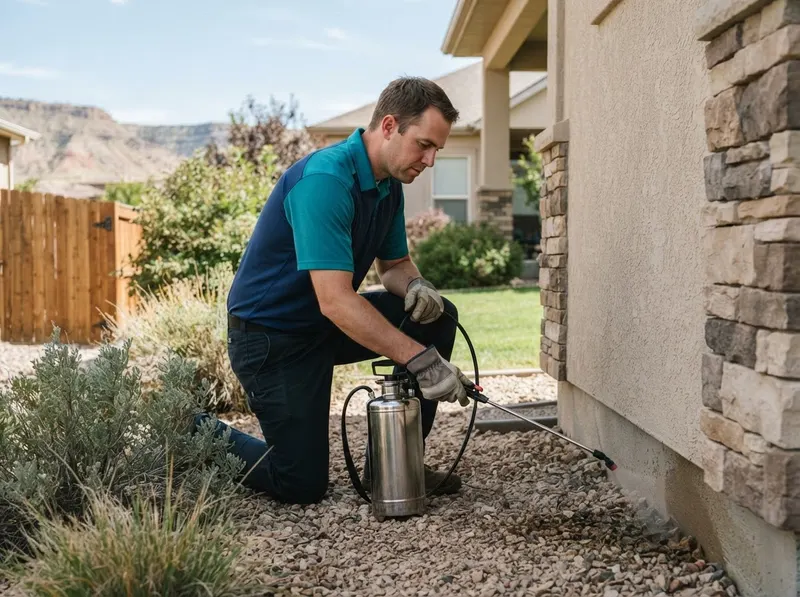
General pest perimeter defense creates an unbroken boundary against exterior crawling pests using microencapsulated barrier formulations. In Grand Junction, arid climate transitions between the high desert plateaus and irrigated turf drive rapid insect migration toward structure foundations. Applying an exterior barrier treatment 3 feet up the exterior foundation stem wall and 3 feet out onto surrounding soil or gravel arrests insect pathways. This treatment differs from interior-only sprays by stopping active populations outside, eliminating the need to move interior furniture or vacate rooms during application. Homes in the Redlands and near the Ridges bordering the rocky ravines of Colorado National Monument encounter intense populations of black widows and western subterranean insects, while irrigated properties in Fruitvale, Orchard Mesa, and Appleton contend with earwigs and field ants moving through moisture gradients.
Technicians from Virexa Insect Solutions apply dry granular barrier formulations across landscaped perimeters up to 10 feet out from structures, followed by liquid applications to crack-and-crevice entryways, hose bibs, and expansion joints. In Downtown Grand Junction and Pomona Park, mature trees and irrigation channels encourage boxelder bugs and elm seed bugs to congregate on sun-facing south and west masonry walls. While a standard perimeter treatment blocks structural invaders, it is distinct from tree spraying or interior baiting programs; dense infestations inside closed drywall voids require targeted interior voids or attic dusting rather than perimeter bands alone. A single perimeter defense application typically maintains chemical integrity for 60 to 90 days under direct Grand Valley sun, though persistent alkaline soil along Pear Park and North Grand Junction requires regular seasonal renewals to prevent residual breakdown.
The logistical workflow follows four concrete steps: 1. The exterior perimeter is cleared of hoses, tools, and pet items along the entire structure foundation. 2. A calibrated 3-foot vertical and horizontal liquid barrier is applied to concrete, siding junctions, and window wells. 3. Granular water-activated barriers are dispersed along mulched landscape beds within 10 feet of exterior siding. 4. Accessible weep holes, cable entry points, and utility conduits receive focused mechanical sweeps or micro-deposit treatments.