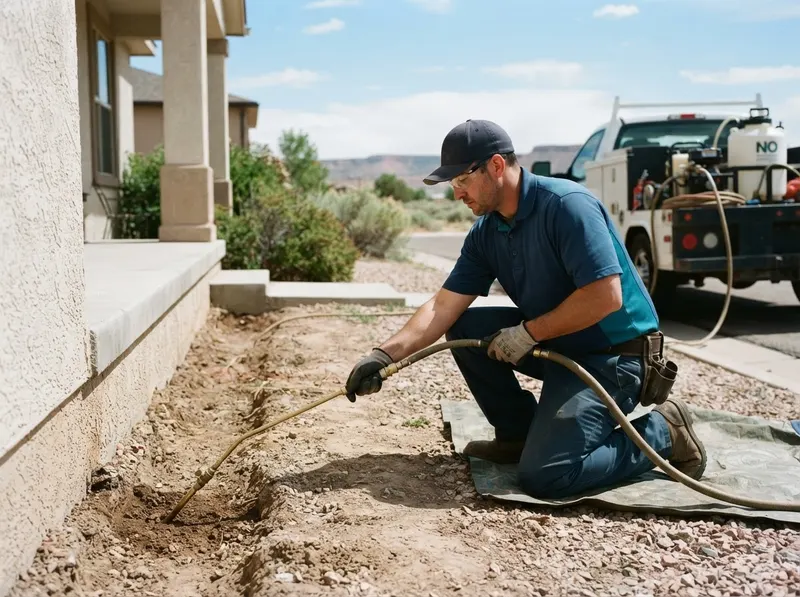
Subterranean termite soil treatment protects residential and commercial structures from subterranean wood-destroying insects native to Mesa County, including the arid-land subterranean termite (Reticulitermes tibialis). The process requires establishing a continuous zone of liquid non-repellent termiticide, such as fipronil or imidacloprid, around exterior foundation walls. Field workers dig a continuous 6-inch-wide by 6-inch-deep trench directly against exterior footings, rod-injecting liquid material at an EPA-registered application volume of 4 gallons per 10 linear feet per foot of depth. When structures feature attached concrete flatwork, including patios, driveways, or garage slabs, technicians drill 0.5-inch access holes spaced every 12 inches along the perimeter to treat the underlying soil, subsequently sealing every opening with structural hydraulic cement.
Soil composition across the Grand Valley directly affects chemical dispersion rates. In lower-elevation sectors such as Orchard Mesa, Fruitvale, and Pear Park, agricultural clay-loam soils retain moisture and slow chemical lateral absorption, requiring continuous pressure injection at 25 to 30 PSI to ensure uniform chemical saturation. Conversely, properties situated along elevated benches in the Redlands and the Ridges, as well as homes bordering the Connected Lakes section of James M. Robb - Colorado River State Park, sit on gravelly, alluvial sand and sandstone bedrock. Sandier soils exhibit rapid percolation, which demands precise volume regulation to avoid downward chemical leaching past targeted subterranean nesting zones. Structures located in Downtown Grand Junction, Pomona Park, Appleton, and North Grand Junction frequently present mixed soil conditions and legacy fieldstone or cinder block stem walls that require crawlspace perimeter trenching in addition to exterior ground work.
Liquid soil treatment provides complete structural exclusion, contrasting directly with localized topical spot treatments or exterior bait stations. While baiting stations require foraging worker termites to discover monitoring tubes over a span of 60 to 180 days, a liquid chemical barrier provides an immediate continuous defensive barrier around the foundation footprint. The operational trade-off of a trench-and-drill liquid barrier is the physical modification required during installation: drilling through interior expansion joints, tile entryways, or adjacent exterior concrete flatwork is necessary to treat void spaces underneath. For expansive structural footprints with complex grade changes near Colorado National Monument, liquid soil treatments eliminate subterranean foraging tunnels through mortar joints, brick weep holes, and plumbing utility penetrations.